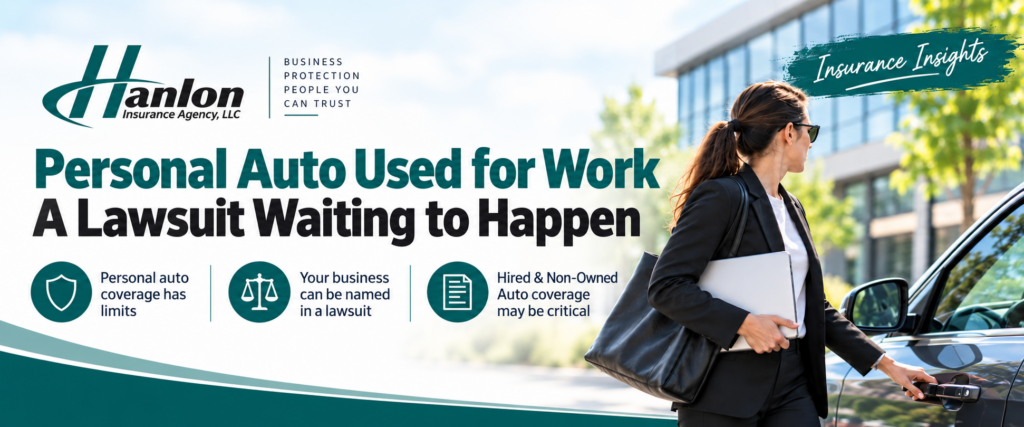
Using an employee’s personal vehicle for company business can seem harmless. Someone runs to pick up supplies, drives to a customer meeting, makes a delivery, or stops at a job site.
The exposure usually does not become obvious until there is an accident.
When employees use personally owned vehicles for business purposes, their personal auto insurance may not provide all the protection the employee—or the employer—assumes it does. Certain types of business use may be limited or excluded depending on the policy and circumstances.
More importantly, if an employee causes an accident while acting on behalf of the company, the business itself may also be pulled into the claim or lawsuit.
Common Ways Employees Use Personal Vehicles for Business
This exposure exists in more businesses than many owners realize. Employees may use their own vehicles to:
- Visit customers or job sites
- Pick up materials or supplies
- Make deliveries
- Run errands for the company
- Attend meetings or training
- Travel between business locations
- Transport documents, equipment, or other company property
Even occasional use can create an exposure.
The Employee’s Personal Auto Policy May Not Be Enough
When an employee is driving their own vehicle, their personal auto policy will generally be an important source of coverage.
But that does not automatically mean the employer is adequately protected.
Personal auto policies are designed primarily around the individual vehicle owner. Coverage can vary depending on how a vehicle is being used, and some business activities may be subject to restrictions or exclusions.
If an injured party alleges that the employee was acting within the course and scope of employment, the employer can also be named in a claim or lawsuit.
A Serious Accident Can Exceed Personal Liability Limits Quickly
A major automobile accident can involve:
- Significant bodily injury
- Multiple injured parties
- Medical expenses
- Lost wages
- Permanent disability
- Property damage
- Legal defense costs
An employee carrying relatively modest personal liability limits may not have enough insurance to respond to a severe accident.
That is where the company’s own insurance program becomes important.
Where Hired and Non-Owned Auto Liability Fits
Hired and Non-Owned Auto Liability, often abbreviated HNOA, can help protect a business when vehicles it does not own are used for company purposes.
For employee-owned vehicles, the relevant portion is typically Non-Owned Auto Liability.
This coverage does not insure the employee’s vehicle itself and does not replace the employee’s personal auto insurance. Its purpose is to help protect the business from liability arising out of the use of a non-owned vehicle for company business, subject to the terms and conditions of the policy.
Business Owners Should Review
If employees use personal vehicles for work, business owners should consider:
- Whether employees ever use their own vehicles for company business
- How frequently those vehicles are used
- What types of business trips employees make
- Whether Hired and Non-Owned Auto Liability is included in the insurance program
- Whether current liability limits are adequate
- Whether employees are required to maintain minimum personal auto liability limits
- Whether the company has procedures for reviewing driver records and proof of insurance
The important question is not simply:
“Does the employee have car insurance?”
The better question is:
“What happens to my business if that employee causes a serious accident while working for me?”
Review the Exposure Before There Is an Accident
Personal vehicles used for company business can be easy to overlook because the company does not own the automobile.
But ownership of the vehicle and liability for an accident are not necessarily the same thing.
If employees use their own vehicles for company business—even occasionally—it is worth reviewing the exposure and making sure the commercial insurance program is structured appropriately.
Related: Distracted Driving = Nuclear Verdicts: Why One Glance at a Phone Can Put Your Business on Trial
At Hanlon Insurance Agency, LLC, our executive officers hold the CPCU and CIC professional insurance designations. We help New Jersey businesses identify coverage gaps, evaluate liability exposures, and better understand where unexpected insurance problems can arise.
Have employees using personal vehicles for company business?
Call or text 973-909-9889 to review the exposure.
A Policy of Mutual Trust and Respect